
Casino Payment Methods: How to Pay, Cash Out and Stay Safe
Casino Payment Methods: How to Pay, Cash Out and Stay Safe ! Sketches of payment objects frame a clear title space The best casino payment method is the one that is accepted where you play, costs you little, pays out in your own name and lets you cap your spending.
The best casino payment method is the one that is accepted where you play, costs you little, pays out in your own name and lets you cap your spending. At a brick-and-mortar casino that usually means cash, a debit card or the property’s own cashless wallet. Online it usually means a debit card, an e-wallet or a bank-based transfer. Below is how each works, what it costs, how fast money comes back and what to check before you deposit.
If your plan is a trip rather than a browser tab, start with the place. On FeltFinder you can browse nearly 3,000 listed casinos and poker rooms, then check each tournament’s buy-in, entry fee, re-entry rules and guarantee, so you know how much you need to bring or load before you arrive.
TL;DR
- Debit cards are the default for deposits; e-wallets and bank-based transfers are usually quicker for getting money back, and crypto is refused by some regulated markets.
- Deposit costs vary by method, from about 0% on some e-wallets to 9.5–15% on prepaid vouchers, and payout times run from minutes to several business days.
- Name matching matters: withdrawals normally go back to an account in your own name, after identity checks.
- At a casino in person, cash at the cage, chips and a growing number of mobile wallets are the main routes, so know your buy-in before you go.
- Set a deposit limit first. Regulators in several countries now build limit-setting into the sign-up process.
Table of Contents
- The main casino payment methods
- What each method costs
- How withdrawals work
- Paying at a casino in person
- How to choose a payment method
- Keeping payments secure
- Set limits before you pay
- Find the room, then plan the payment
- FAQ
- Sources
The main casino payment methods
Whether you play online or walk through the doors, every payment method falls into a handful of families. They differ in speed, cost and how much of your financial information the casino sees.
| Method | Typical use | Strength | Watch for |
|---|---|---|---|
| Debit card | Deposits, sometimes withdrawals | Familiar, instant deposits | Banks may block gambling codes; slower payouts |
| Credit card | Deposits where allowed | Widely held | Fees, debt risk, banned in some markets |
| E-wallet | Deposits and withdrawals | Fast payouts, keeps card details off the casino site | Fees on some wallets; bonus exclusions |
| Bank transfer / ACH / open banking | Deposits and withdrawals | Direct from your account | Payouts can take days |
| Prepaid voucher | Deposits only in most cases | No bank details shared | High cost to the operator, limited payouts |
| Mobile pay (Apple Pay, Google Pay, carrier billing) | Deposits, some withdrawals | Convenient | Low caps on carrier billing |
| Crypto | Deposits and withdrawals | Fast on-chain | Not accepted in some regulated markets |
| Cash | In-person play | No paper trail on your card | Carrying it; limits and reporting thresholds |
Cards
Cards are the most common route because nearly everyone already has one. You enter the card number, expiry date and security code, and if your bank asks, you confirm the payment in its app. Funds usually arrive at once. Debit is the cleaner choice because you spend what is in your account. Credit is restricted in some places: the UK has barred casinos from accepting credit cards since 2020, and Ontario’s regulator prohibits operators from extending credit to players.
A frequent reason for a failed card deposit is the bank itself. Banks can block or cap gambling transactions on cards, and the Racing Post notes that removing such a block is not instant. If a deposit fails, call your bank before trying another card three times.
E-wallets and mobile payments
An e-wallet is a digital account you fund from your bank or card and then use to pay. The casino sees the wallet, not your card number. That is why wallets are popular for withdrawals as well as deposits. Apple Pay and Google Pay work the same way for deposits, and where a casino allows it, payouts to them can arrive within as little as four hours. Pay-by-phone-bill deposits are usually small, capped around £30 in the UK, and they cannot be used to withdraw.
Bank transfers, ACH and open banking
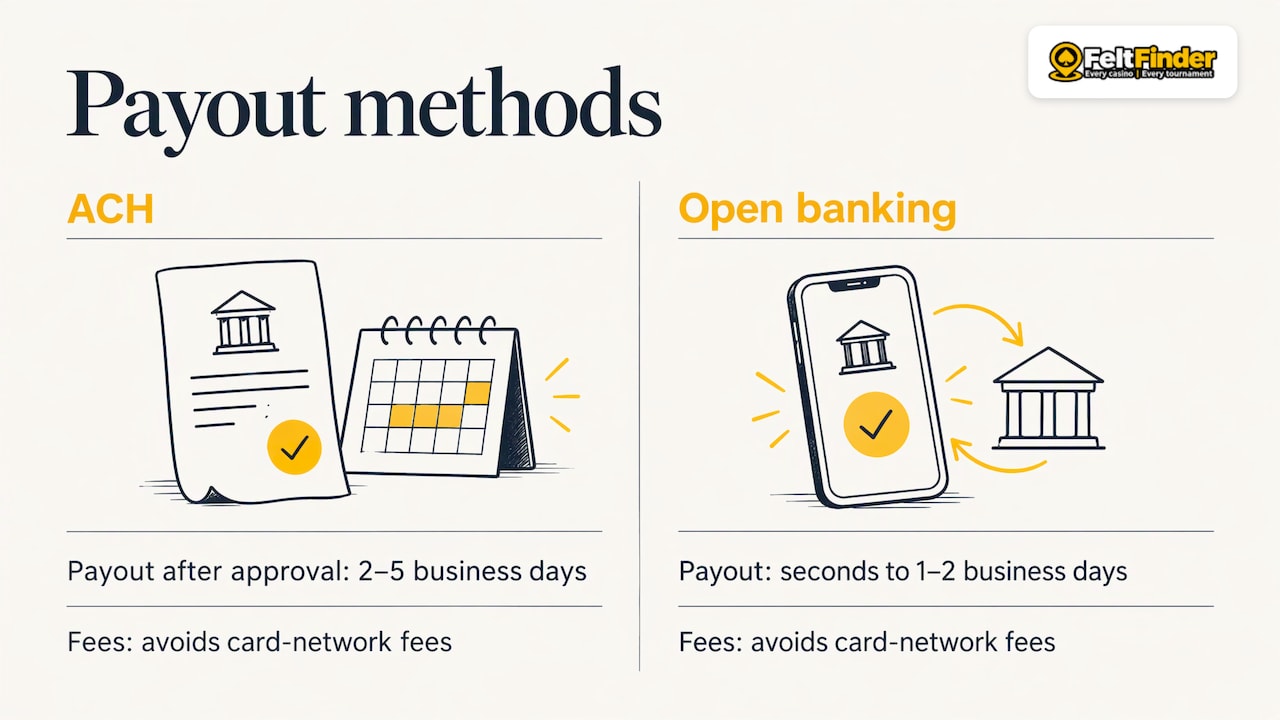
In the US, ACH is the electronic bank-to-bank network behind most direct deposits. Open banking services let you approve a payment straight from your bank without typing card details. Both avoid card-network fees, which is why operators often like them. The trade-off is on the way out: payouts by ACH tend to take 2–5 business days after approval, while open banking can be as quick as seconds to 1–2 business days.
Prepaid vouchers and crypto
Prepaid vouchers let you pay without sharing bank details, and they suit people who want a hard spending ceiling. They are mostly deposit-only. Crypto can settle in minutes, but not every regulator allows it. Ontario’s rules, for example, treat it as not legal tender and refuse it. Check that your jurisdiction and your casino accept it before you buy any.
What each method costs
Players rarely pay a deposit fee directly, but your bank, wallet or card issuer sometimes does charge one, and some casinos pass costs on. A 2026 industry guide puts the operator’s own cost per method in these ranges:
| Method | Operator cost per deposit |
|---|---|
| Cards | 1–5% |
| E-wallets | 0–2.9% |
| Open banking | 0–2.5% |
| Crypto | 0.15–2% |
| Mobile money | 1.5–3% |
| Prepaid vouchers | 9.5–15% |
Those figures come from the iGaming payment methods guide, and they describe what operators pay, not what you will be charged. They matter to you for one reason: a method that is expensive for the casino is often the one excluded from welcome bonuses or capped at low limits. Read the cashier page and the bonus terms before you choose.
Watch for fees on your side too. The Responsible Gambling Council in Canada specifically advises players to watch for hidden credit-card fees, because a card cash-advance charge on a gambling deposit can add up fast.
How withdrawals work
Playing is easy. Getting paid is where the payment method counts. The sequence is the same almost everywhere:
- You request a payout in the cashier.
- The casino checks your identity (known as KYC, short for know your customer) and screens the transaction for money laundering.
- The casino approves the payout internally, which can take hours to a couple of days.
- The money moves by your chosen rail, and that rail sets the final wait.
After approval, reported timings are roughly: e-wallets instant to 24 hours, open banking seconds to 1–2 business days, crypto instant to 3 days, cards 1–5 days and mobile money 24 hours to 3 business days.
Why a withdrawal gets rejected
The most common cause is a mismatch. Regulated casinos pay out only to an account you legally hold, a rule written into Ontario’s standards, so your casino account name has to match your bank or wallet name exactly. The same standards require extra verification when winnings reach $10,000 or more. Do your ID verification before you win, not after. Upload your documents when you open the account so the first payout is not stalled.
One more practical habit: withdraw to the same method you deposited with whenever the casino allows it. Many operators run on that principle, and it keeps the verification trail short.
Paying at a casino in person
A physical casino works differently, and the choices are simpler.
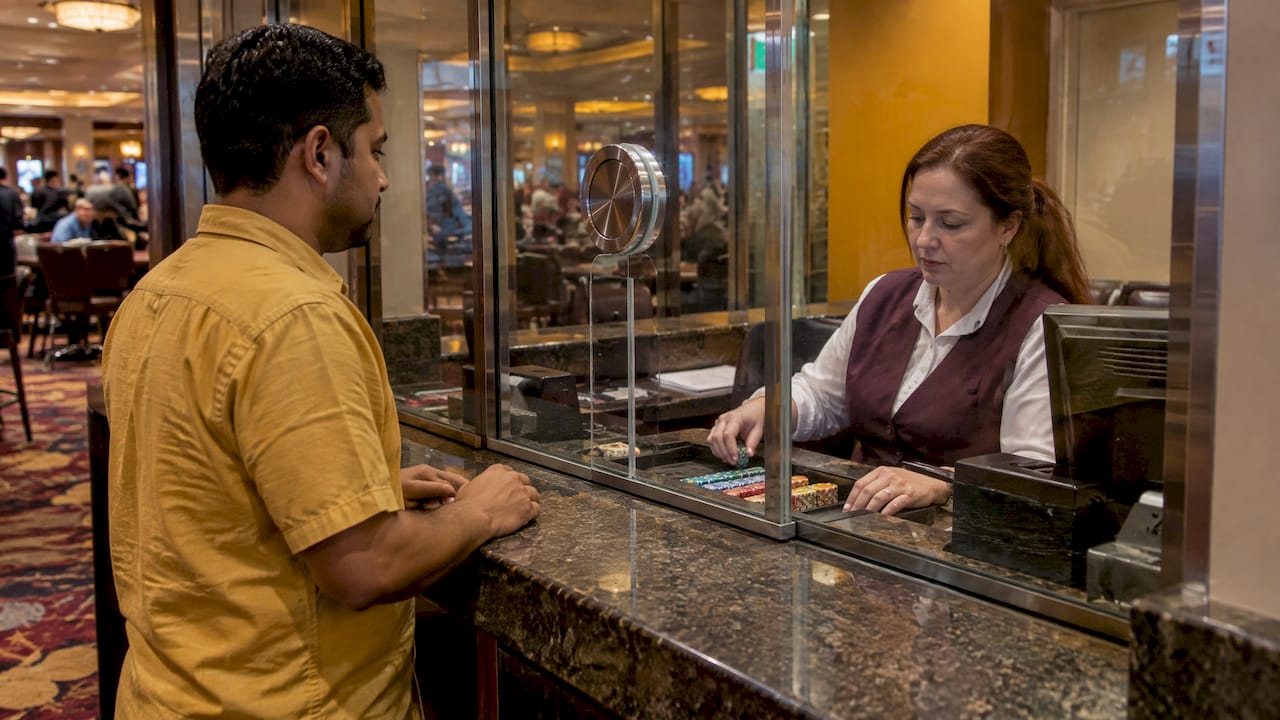
Cash at the cage. The cage is the cashier window. You can exchange cash for chips or tickets and cash out winnings there. For poker, you register for a tournament at the poker room or cage, pay the buy-in and entry fee, and receive your starting stack.
Cash machines and card advances. Most casino floors have ATMs and cash-advance stations. These often carry convenience fees, and a cash advance on a credit card is usually charged as a loan from day one. Using a debit card, or withdrawing from your own bank before you travel, avoids that.
Mobile wallets. Cashless gaming is spreading in Nevada. Regulators approved the technology, and Las Vegas casinos now let guests fund slot play and even buy table chips from a mobile wallet, loaded from a debit card, bank account or PayPal. Whether a property offers it varies, so check the casino’s app or desk.
Large wins. Big payouts can trigger identity checks and tax paperwork, so carry a government ID to any casino you plan to play at seriously.
Budget the buy-in, not just the bankroll
Poker players have an extra reason to plan payments: tournament cost is more than the headline buy-in. Entry fees, re-entries and add-ons all draw on your funds. Before you travel, look at the schedule and work out your maximum spend, including a re-entry if the event allows it. The FeltFinder tournament schedule lets you filter by buy-in, guarantee, date and status, so you can see which events fit the money you plan to bring.
How to choose a payment method
Work through these in order:
- Check it is allowed where you are. Rules differ by country, state and province. Only use licensed operators in your jurisdiction.
- Pick a method in your own name. It must match your casino account for withdrawals.
- Prefer debit over credit. New Zealand’s official safer-gambling guidance recommends a debit card with limits over a credit card.
- Match the method to how you cash out. If speed matters, an e-wallet or open banking route is typically quicker than a card or ACH.
- Read the bonus terms. Some methods are excluded from offers.
- Check the limits. Minimums, maximums and daily caps differ by method and casino.
Keeping payments secure
A few checks cover most of the risk. Look for “https” and the padlock in your browser, and avoid saving card details so top-ups cannot happen automatically, as the New Zealand guidance advises. Use strong two-factor authentication where offered. Denmark’s regulator, for instance, requires it for deposits, withdrawals and payment-instrument changes. In the UK, check the licence number at the bottom of the homepage, as the Racing Post suggests.
Regulators also expect operators to protect your card data. Malta’s authority requires licensees to store card numbers in encrypted form with PCI DSS compliance evidence. A licensed casino that holds a credible regulator’s approval is a much safer place to leave payment details than an unlicensed site.
Set limits before you pay
The payment method is also your spending control. Cards, wallets and bank accounts can all carry gambling blocks, and the Racing Post notes that many UK banks let you block gambling transactions or set daily, weekly or monthly caps. PayPal offers a block in its payment preferences.
On the casino side, rules are tightening. The UK’s RTS 12, in force from 31 October 2025, requires easy-to-find financial limits and a prompt to set one at registration or first deposit. A limit increase needs a 24-hour cooling-off period, while a reduction applies immediately. Denmark’s guidance is similar: the player must choose a deposit limit before play starts, and increases take effect only after 24 hours.
Wherever you play, set the limit first and treat it as a fixed cost. If you like to think about bankroll mathematically, this explanation of the risk of ruin in betting shows why stake size relative to your funds decides how long you last.
If gambling stops being fun, use the self-exclusion and blocking tools your regulator and casino provide, and contact your local problem gambling helpline. In the US, the National Problem Gambling Helpline is the place to start.
Find the room, then plan the payment
The payment question gets simpler once you know where you are playing and what it costs to sit down. FeltFinder is a free-to-browse directory of casinos and poker rooms with a tournament schedule you can search by date, location, venue, event type, buy-in, guarantee and status, including live and registration-closed events. A free account gives you access to series details, and you can save events and share them to your calendar.
Looking at a trip? Browse casinos in Las Vegas, Atlantic City, California or Florida, or go straight to the poker tournaments in Las Vegas.

If you travel, the London and Macau schedules are listed the same way, so you can compare entry fees before you decide where to go.
FAQ
What is the best payment method for casinos?
For most players it is a debit card for deposits and an e-wallet or bank-based route for withdrawals, because those combine familiarity with quicker payouts. The right answer depends on what your casino and your country allow. Choose a method in your own name so withdrawals are not held up.
How do you pay in a casino?
In person, you hand cash to the cage or a dealer in exchange for chips, or use a casino’s cashless mobile wallet where one is offered. For a poker tournament, you pay the buy-in and entry fee at registration. Bring government ID for larger transactions.
How do online casinos pay you?
You request a withdrawal in the cashier. The casino verifies your identity, approves the payout, and sends the money to a method in your name. Timing then depends on the rail: e-wallets are often within a day, cards and ACH take several business days.
Can you use a credit card to gamble at a casino?
In many places you can, but not everywhere. The UK has banned credit cards for gambling since 2020, and Ontario operators may not extend credit. Even where it is allowed, a debit card keeps spending tied to money you already have, and fees on cash advances can be steep.
Sources
- Casino Payment Methods guide, The Independent
- iGaming Payment Methods: Complete Operator’s Guide
- Canada iGaming Payments: Interac e-Transfer, Rules and More
- Registrar’s Standards for Gaming, AGCO
- Safer Gambling Tools & Tips for Online Bettors, Racing Post
- Online gambling, safergambling.org.nz
- Tips to Keep Your Gambling Safe, Responsible Gambling Council
- Danish Gambling Authority, base platform requirements
- Danish Gambling Authority, responsible gambling guidance
- Malta Gaming Authority, Compliance Audit Manual
- UK Gambling Commission, RTS 12 wording from 31 October 2025
- Resorts World extends cashless wagering to table games, The Nevada Independent
- Risk of ruin in betting, DonkeyRadar